
University of Georgia Athletics
‘We Have Leadership All Over The Place’
June 05, 2026 | Baseball
By Kyle Tatelbaum
UGA Sports Communications
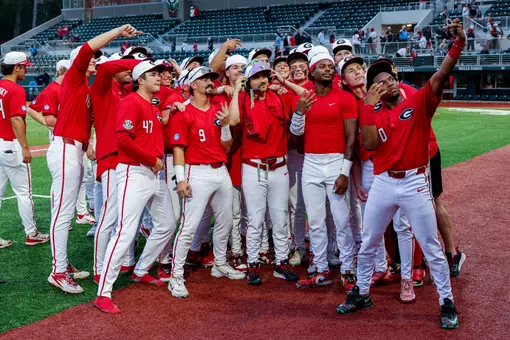
Georgia's push to the NCAA baseball tournament Super Regionals has been powered by production on the field, but sustained by something less measurable: leadership.
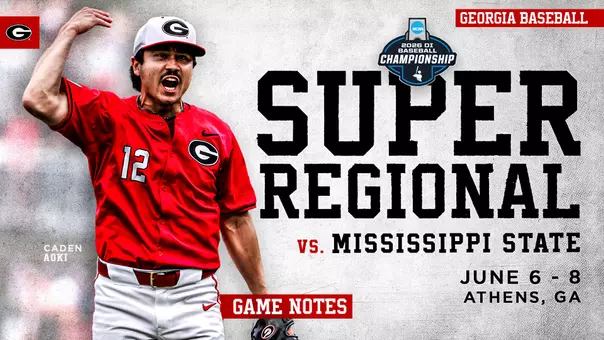
As third-seeded Georgia prepares to face No. 14 Mississippi State starting Saturday at 11 a.m. at Foley Field, that internal framework, built around veteran voices like Kolby Branch, Daniel Jackson and Tre Phelps, has become a central reason the Bulldogs have navigated both the volatility of SEC play, winning the conference regular-season and tournament titles, and the intensity of the postseason.
Ike Cousins Head Baseball Coach Wes Johnson has pointed to that dynamic as a differentiator, particularly in how the team balances competitiveness with approachability over the course of a long season.
"Man, they love coming to the yard every day," Johnson said. "They want to play. … They know how to be serious, but they also know how to have fun, and it's great being around them every single day."
That balance has translated into steadiness, especially in moments where postseason games often hinge on emotional control as much as execution.
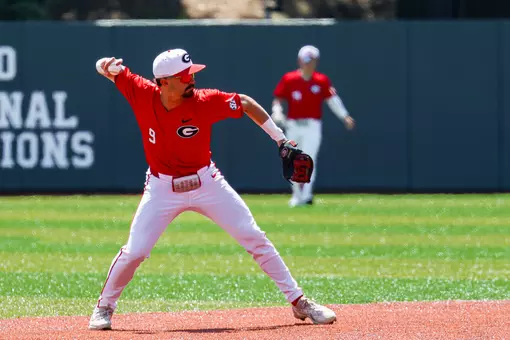
At the center of that is the third-year Bulldog Branch, whose experience in the SEC has given Georgia a reliable emotional baseline.
"Yeah, Kolby (Branch), we call him 'Sheriff' or 'Captain' or whatever," Johnson said. "He's just been in this league. He's an old player. Old players in this league, nothing really surprises them."
Branch's presence minimizes irresolution. In practical terms, that shows up in situational at-bats, defensive reliability, and just as critically, the ability to control the dugout.
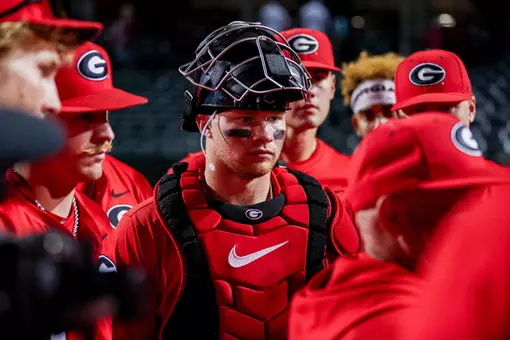
Behind the plate, Jackson, the SEC Player of the Year, provides a complementary form of leadership, one that directly impacts game management. His growth has coincided with the development of Georgia's pitching staff, where communication, tempo and trust are essential variables.
"To see Daniel's growth, not only as a player, but as a leader, especially of the pitching staff back there behind the plate, is something that we could talk about for a long time," Johnson said.
Jackson describes the team's leadership model as decentralized, with clearly defined roles that collectively maintain clubhouse equilibrium.
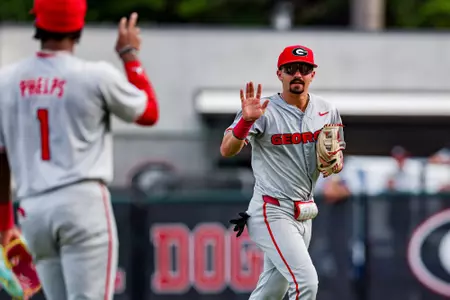
"It's helped a ton," Jackson said. "I mean, we have tons of different leadership in different ways. Having Kolby as kind of our main leader is great. … And then I try to lead by example. And then Tre Phelps just being probably the best team locker room guy there is. We have leadership all over the place."
That last component, Phelps' presence, becomes especially significant in the context of Game 1.
After being ejected following a go-ahead home run during the regional round against Liberty, Phelps is unavailable for the Super Regional opener. While his absence in the lineup will be felt on the field and by fans both at Foley and on the couch, his vacancy in the dugout may have a larger impact.
In analytical terms, that matters.
Phelps' value extends beyond on-field metrics; he functions as a stabilizer in high-stress moments, helping regulate energy across the roster. His ability to keep the clubhouse loose without losing focus has been a consistent feature of Georgia's identity, particularly during momentum swings.
Without him in Game 1, that responsibility becomes redistributed. Branch's composure and Jackson's command of the pitching staff will likely take on added weight, while other veterans will need to fill the interpersonal gap Phelps typically occupies.
It is a subtle shift, but one that can influence communication patterns, emotional pacing and overall dugout cohesion, all factors that tend to surface in tightly contested postseason games.
Still, Georgia's broader leadership structure is designed to absorb exactly this kind of disruption.
Because if the Bulldogs have demonstrated anything over the course of the season, it is that their leadership is not dependent on a single voice, but reinforced by many.
And in a Super Regional environment, that redundancy may be as valuable as any statistic.
UGA Sports Communications
Georgia's push to the NCAA baseball tournament Super Regionals has been powered by production on the field, but sustained by something less measurable: leadership.
As third-seeded Georgia prepares to face No. 14 Mississippi State starting Saturday at 11 a.m. at Foley Field, that internal framework, built around veteran voices like Kolby Branch, Daniel Jackson and Tre Phelps, has become a central reason the Bulldogs have navigated both the volatility of SEC play, winning the conference regular-season and tournament titles, and the intensity of the postseason.
Ike Cousins Head Baseball Coach Wes Johnson has pointed to that dynamic as a differentiator, particularly in how the team balances competitiveness with approachability over the course of a long season.
"Man, they love coming to the yard every day," Johnson said. "They want to play. … They know how to be serious, but they also know how to have fun, and it's great being around them every single day."
That balance has translated into steadiness, especially in moments where postseason games often hinge on emotional control as much as execution.
At the center of that is the third-year Bulldog Branch, whose experience in the SEC has given Georgia a reliable emotional baseline.
"Yeah, Kolby (Branch), we call him 'Sheriff' or 'Captain' or whatever," Johnson said. "He's just been in this league. He's an old player. Old players in this league, nothing really surprises them."
Branch's presence minimizes irresolution. In practical terms, that shows up in situational at-bats, defensive reliability, and just as critically, the ability to control the dugout.
Behind the plate, Jackson, the SEC Player of the Year, provides a complementary form of leadership, one that directly impacts game management. His growth has coincided with the development of Georgia's pitching staff, where communication, tempo and trust are essential variables.
"To see Daniel's growth, not only as a player, but as a leader, especially of the pitching staff back there behind the plate, is something that we could talk about for a long time," Johnson said.
Jackson describes the team's leadership model as decentralized, with clearly defined roles that collectively maintain clubhouse equilibrium.
"It's helped a ton," Jackson said. "I mean, we have tons of different leadership in different ways. Having Kolby as kind of our main leader is great. … And then I try to lead by example. And then Tre Phelps just being probably the best team locker room guy there is. We have leadership all over the place."
That last component, Phelps' presence, becomes especially significant in the context of Game 1.
After being ejected following a go-ahead home run during the regional round against Liberty, Phelps is unavailable for the Super Regional opener. While his absence in the lineup will be felt on the field and by fans both at Foley and on the couch, his vacancy in the dugout may have a larger impact.
In analytical terms, that matters.
Phelps' value extends beyond on-field metrics; he functions as a stabilizer in high-stress moments, helping regulate energy across the roster. His ability to keep the clubhouse loose without losing focus has been a consistent feature of Georgia's identity, particularly during momentum swings.
Without him in Game 1, that responsibility becomes redistributed. Branch's composure and Jackson's command of the pitching staff will likely take on added weight, while other veterans will need to fill the interpersonal gap Phelps typically occupies.
It is a subtle shift, but one that can influence communication patterns, emotional pacing and overall dugout cohesion, all factors that tend to surface in tightly contested postseason games.
Still, Georgia's broader leadership structure is designed to absorb exactly this kind of disruption.
Because if the Bulldogs have demonstrated anything over the course of the season, it is that their leadership is not dependent on a single voice, but reinforced by many.
And in a Super Regional environment, that redundancy may be as valuable as any statistic.
Players Mentioned


Friday, June 05
Friday, June 05
Sunday, May 31
Sunday, May 31