
University of Georgia Athletics
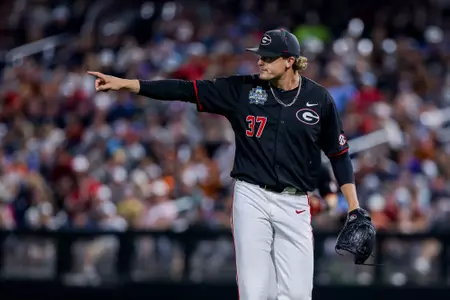
Photo by: Conor Dillon/UGAAA
June 14, 2026 | Baseball
By Kyle Tatelbaum
UGA Sports Communications
The first inning told you everything.
Georgia pitcher Joey Volchko walked to the mound at Charles Schwab Field with 25,002 people settled in and the stakes of the College World Series pressing from all sides. He fell behind 3-1 to the first Texas hitter he faced.
Then he struck him out anyway.
Two batters later, the Longhorns were back in the dugout. Three strikeouts. And Georgia, almost immediately, was playing Volchko's game.
By the end of the night, everyone else was, too.
Volchko delivered one of the most dominant starts in Georgia postseason history, striking out 15 while throwing a complete game as the No. 3-seeded Bulldogs beat No. 6 Texas, 7–1. He improved to 11–2 on the season, and in the process, set a program record for strikeouts in a College World Series game, while also throwing Georgia's first complete game of the year, and its first in Omaha since the 1990 national title run.
It wasn't just dominance. It was control of the entire environment.
"I felt a lot of confidence and comfort with the game plan we came in with tonight," Volchko said. "We had a very clear plan and executed."
The plan centered on one thing: getting ahead. Volchko threw first-pitch strikes to 74 percent of hitters, a number that explains nearly everything that followed. Texas spent the night reacting. protecting, expanding, guessing.
Volchko spent it dictating.
His pitch count showed the shift. Earlier this season, his longest outing, 6.2 innings, required 102 pitches. On Saturday, he reached that same mark in just 75. There was no visible stress, no inning when Georgia had to consider going to the bullpen.
Even the lone walk he allowed didn't come until the ninth inning.
"He had his 'A' game tonight," Texas coach Jim Schlossnagle said. "I don't know if he's had a better game than that."
The difference from earlier in the postseason was subtle but significant.
In the regional round, Volchko threw six no-hit innings with 10 strikeouts against LIU, but walked four. In the Super Regional against Mississippi State, he had to navigate a six-run inning before settling in and giving Georgia a chance to come back.
This time, there was nothing to traverse.
He struck out the side in the first and did it again in the fourth. And in between, he filled the strike zone with a mix that has evolved over the course of the season: fastball, slider, curveball and changeup. He had it all against Texas.
"If we called it low and away, he hit it," Georgia's Ike Cousins Head Baseball Coach, Wes Johnson, said. "If we called the slider strike-to-ball, he did it. One of the most impressive complete-game performances I've been a part of."
Performances like that do more than win games in Omaha. They travel.
With the MLB Draft approaching, evaluators place particular weight on outings like this, against elite competition, in a neutral environment, with pressure that closely mirrors professional baseball. Volchko checked each box. He showed durability, carrying his stuff through nine innings. He showed command, limiting walks and living in the strike zone. And he showed the ability to miss bats in multiple ways, recording 15 punchouts.
Just as important, he showed composure.
For a pitcher whose development this season has included refining his arsenal and improving strike consistency, Sunday offered a consolidated version of his progress. In Omaha, it all showed up at once.
That combination, stuff, strike-throwing, and poise on a national stage, tends to resonate with decision-makers.
Georgia's offense gave him early support and added on late, continuing a season-long trend. The Bulldogs have now held opponents to three runs or fewer 31 times this season, pushing their record to 52–12, tied for the most wins in program history.
But this night belonged to Volchko.
He ended it the same way he started it: with a fastball for a strike. No deviation, no drama. Just execution.
And, perhaps, a performance that did not just define Georgia's opener in Omaha, but meaningfully reshaped how the baseball world views what comes next for him.
UGA Sports Communications
The first inning told you everything.
Georgia pitcher Joey Volchko walked to the mound at Charles Schwab Field with 25,002 people settled in and the stakes of the College World Series pressing from all sides. He fell behind 3-1 to the first Texas hitter he faced.
Then he struck him out anyway.
Two batters later, the Longhorns were back in the dugout. Three strikeouts. And Georgia, almost immediately, was playing Volchko's game.
By the end of the night, everyone else was, too.
Volchko delivered one of the most dominant starts in Georgia postseason history, striking out 15 while throwing a complete game as the No. 3-seeded Bulldogs beat No. 6 Texas, 7–1. He improved to 11–2 on the season, and in the process, set a program record for strikeouts in a College World Series game, while also throwing Georgia's first complete game of the year, and its first in Omaha since the 1990 national title run.
It wasn't just dominance. It was control of the entire environment.
"I felt a lot of confidence and comfort with the game plan we came in with tonight," Volchko said. "We had a very clear plan and executed."
The plan centered on one thing: getting ahead. Volchko threw first-pitch strikes to 74 percent of hitters, a number that explains nearly everything that followed. Texas spent the night reacting. protecting, expanding, guessing.
Volchko spent it dictating.
His pitch count showed the shift. Earlier this season, his longest outing, 6.2 innings, required 102 pitches. On Saturday, he reached that same mark in just 75. There was no visible stress, no inning when Georgia had to consider going to the bullpen.
Even the lone walk he allowed didn't come until the ninth inning.
"He had his 'A' game tonight," Texas coach Jim Schlossnagle said. "I don't know if he's had a better game than that."
The difference from earlier in the postseason was subtle but significant.
In the regional round, Volchko threw six no-hit innings with 10 strikeouts against LIU, but walked four. In the Super Regional against Mississippi State, he had to navigate a six-run inning before settling in and giving Georgia a chance to come back.
This time, there was nothing to traverse.
He struck out the side in the first and did it again in the fourth. And in between, he filled the strike zone with a mix that has evolved over the course of the season: fastball, slider, curveball and changeup. He had it all against Texas.
"If we called it low and away, he hit it," Georgia's Ike Cousins Head Baseball Coach, Wes Johnson, said. "If we called the slider strike-to-ball, he did it. One of the most impressive complete-game performances I've been a part of."
Performances like that do more than win games in Omaha. They travel.
With the MLB Draft approaching, evaluators place particular weight on outings like this, against elite competition, in a neutral environment, with pressure that closely mirrors professional baseball. Volchko checked each box. He showed durability, carrying his stuff through nine innings. He showed command, limiting walks and living in the strike zone. And he showed the ability to miss bats in multiple ways, recording 15 punchouts.
Just as important, he showed composure.
For a pitcher whose development this season has included refining his arsenal and improving strike consistency, Sunday offered a consolidated version of his progress. In Omaha, it all showed up at once.
That combination, stuff, strike-throwing, and poise on a national stage, tends to resonate with decision-makers.
Georgia's offense gave him early support and added on late, continuing a season-long trend. The Bulldogs have now held opponents to three runs or fewer 31 times this season, pushing their record to 52–12, tied for the most wins in program history.
But this night belonged to Volchko.
He ended it the same way he started it: with a fastball for a strike. No deviation, no drama. Just execution.
And, perhaps, a performance that did not just define Georgia's opener in Omaha, but meaningfully reshaped how the baseball world views what comes next for him.

Players Mentioned

RHP
/ BaseballWednesday, June 17
Wednesday, June 17
Monday, June 15
Sunday, June 14